Is there an evergreen campaign that can run every year and yield the same results for retailers selling home furnishing goods? We know, we talk about homemovers a lot. We’d stop if the data let us. Every year, people who’ve collected new keys buy beds, sofas, flooring and kitchens in a predictable order and on a predictable timetable, which is about as close to an evergreen campaign as retail gets.
Regardless of the state of the economy, people are always moving home. This creates a consistent, year-round audience, rather than one limited to a single day or month in the calendar. We anticipate 1.6 million transactions in 2026. That’s 1.6 million households in need of a raft of furniture and furnishings to deck out their new property. And what’s more, movers are unusually open to switching. A move is the one time most people review direct debits with real interest. What’s working? What are they overpaying for? What upgrades should they opt for?
Shrewd retailers know this. They know that life changes can dramatically influence consumer behaviour, with many purchasing decisions triggered by major life events. The research backs this up. In a 2016 field study of 800 people, University of Bath psychologists found that an intervention encouraging more sustainable everyday habits worked better on people who had recently moved home, and suggested the window lasts around three months. Old routines are hard to keep when you can’t remember which drawer the cutlery went in.
Movers are ready to buy and open to new brands, not least because many of them are eating dinner off a cardboard box.
But knowing someone is moving home is only the starting point. Not every purchase happens at the same point in the moving journey. Choosing a broadband provider, or switching the electricity tariff, for example, is an immediate priority and one that is likely booked in before the completion date, while planning a new kitchen is further down the list. By understanding the buying windows, retailers can reach potential customers when their product or service is most relevant.
Homemover orders for national retailers
We analysed some of our top retailer clients’ data to find out when homemovers spend big with retailers.
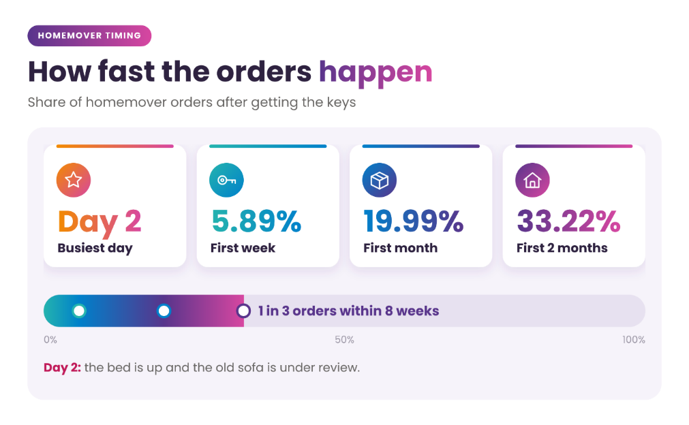
The most popular day for retail orders for a homemover is the second day after the move, when 0.94% of all orders are placed. The first week makes up 5.89% of all orders, 19.99% is the first month, and 33.22% of purchases are within the first two months. Day two is when the bed’s up, the boxes are still taped shut, and someone has noticed how enormous the old sofa looks in the new living room.
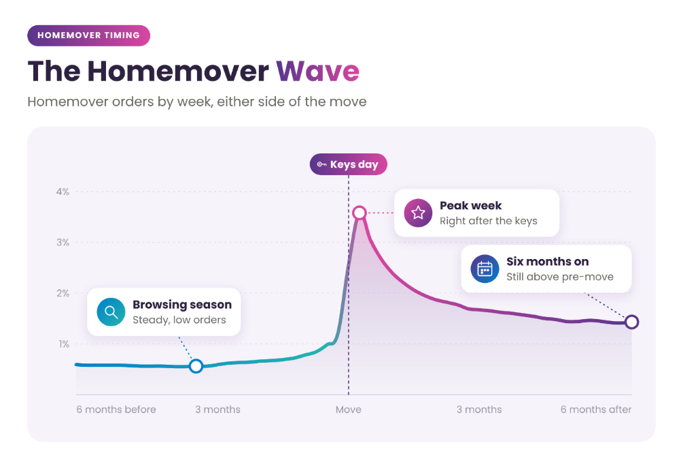
The chart below shows the percentage of orders from homemovers in 2025 in the weeks before and after the move. You can see the peak of orders in those early weeks after the homeowner gets the keys. Before the move, orders start to ramp up, hit a peak, then remain fairly high even months post-move. We call this shape the Homemover Wave. Six months after the move, weekly orders are still running at more than double the level seen six months before.
Looking more closely at the data, we analysed the peak ordering day across four of our national retail clients. Here are the results:
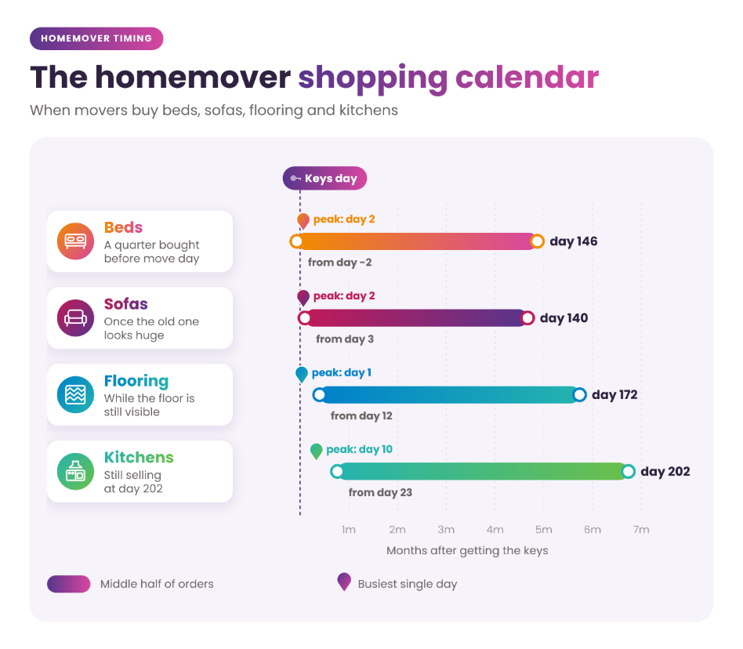
Flooring peaks first, on day one, which is the only day most movers can see the whole floor before the furniture covers it.
Sofa purchases tend to happen relatively soon after a move, with the lower quartile at day 3 and the upper quartile at day 140. The lower quartile is the point by which 25% of purchases have happened, while the upper quartile is the point by which 75% of purchases have happened. Flooring purchases start slightly later but extend over a longer period, ranging from day 12 to day 172. Beds are purchased earlier still, with the lower quartile at two days before the move and the upper quartile at day 146. A quarter of bed orders happen before move day, placed by people who have sensibly ruled out a first night on the floor. Kitchens have a much longer consideration period, with the lower quartile at day 23 and the upper quartile at day 202, almost seven months after movers receive the keys to their new home.
The homemover is a lucrative audience for the retailer, but reaching them at the right moment is key.
Homemovers arrive with a Pinterest board and a budget, then spend the next six months finding out which of the two wins. The retailer that shows up when these purchasing decisions are being considered is the one that has the best chances of being picked.
So, while some marketing teams are busy planning their next seasonal push, the more switched-on retailers are making sure they’re reaching homemovers every single month.